Palma old town on foot: a walking route
Updated 24 November 2026. Opening times along the route checked the same day.
Palma’s old quarter is the area inside the old city walls, one of the largest historic centres in Europe. Its lanes hide the courtyards of noble houses, Gothic churches, modernist shop fronts and old cafés. This route crosses it in a morning at an easy pace, from the bastion of Es Baluard to the cathedral. It works in either direction.
Quick answer
- The route runs from Es Baluard, by the sea, up to Plaça Major, across to Plaça de Cort and down to the cathedral: a morning at an easy pace.
- Highlights: the courtyards of Can Vivot and Casal Balaguer, the Arab Baths, Santa Eulàlia, the Sant Francesc cloister and La Llotja.
- Best time: a weekday morning, when the churches are open. Several close at lunchtime.
- Wear flat shoes: the lanes are stone and some climb.
On this page
- At a glance 20 stops, 4 stretches
- Es Baluard to Weyler the old walls
- Plaça Major squares and courtyards
- Cort and the churches Gothic Palma
- Almudaina and La Seu end of the walk
- La Llotja an evening add-on
- A morning plan from 09:30
- FAQ
The old town with a guide: a walk through the lanes and into the cathedral, entry included
The old town with a guide: a walk through the lanes and into the cathedral, entry included
We may earn a commission when you book through our links. How it works
The route at a glance
The walk follows the itinerary of Palma’s tourist board, in four stretches, from the sea up to the high town and back down to the cathedral.
| Stretch | From and to | Stops | Highlights |
|---|---|---|---|
| 1 | Es Baluard to Plaça de Weyler | 7 | Old walls, Casal Balaguer, modernist facades |
| 2 | Plaça Major to Can Savellà | 6 | Squares, Can Joan de s'Aigo, courtyards |
| 3 | Plaça de Cort to Carrer de la Portella | 4 | Town hall, Santa Eulàlia, Monti-Sion |
| 4 | La Almudaina to the cathedral | 3 | Royal palace, cathedral, Parc de la Mar |
Old town walks with a guide
Palma Old Town & The Cathedral of Mallorca with Mallorcan pastry
An official guide through the lanes, the cathedral with the entry included, and a Mallorcan pastry at the end.
2 hours 30 minutes
Free cancellation
2 h 30With the cathedralfrom €42
Booked on Viator
Palma de Mallorca Must-See Attractions Walking Tour With A Guide
The Arab Baths, La Llotja, Santa Eulàlia and Sant Francesc, with the history of each.
2 hours
Free cancellation
2 hHighlightsfrom €33
Booked on Viator
Palma Food Tour: Tapas, Drinks and Delights with a Local
The same lanes at the pace of the table: local dishes, island wines and the bars locals use.
3 hours
Free cancellation
3 hFoodfrom €89
Booked on Viator
Stretch 1: from Es Baluard to Plaça de Weyler
Start at the Baluard de Sant Pere, a bastion of the Renaissance wall that enclosed the city until the early 20th century. It holds Es Baluard, the museum of modern and contemporary art, and the best view of the old wall above the seafront.
- Walk along the Torrent de sa Riera, the stream bed that once crossed the centre, and enter the old quarter through the Porta de Santa Catalina.
- The Església de l’Anunciació keeps the Cristo de la Sangre, the most revered statue on the island, carried to the cathedral every Maundy Thursday.
- Casal Balaguer has the best-preserved courtyard open to the public in Palma.
- Carrer de la Unió leads to Plaça de Weyler: the modernist Gran Hotel, now the CaixaForum, and the painted shop front of the Forn des Teatre bakery.
Stretch 2: Plaça Major and the quieter squares
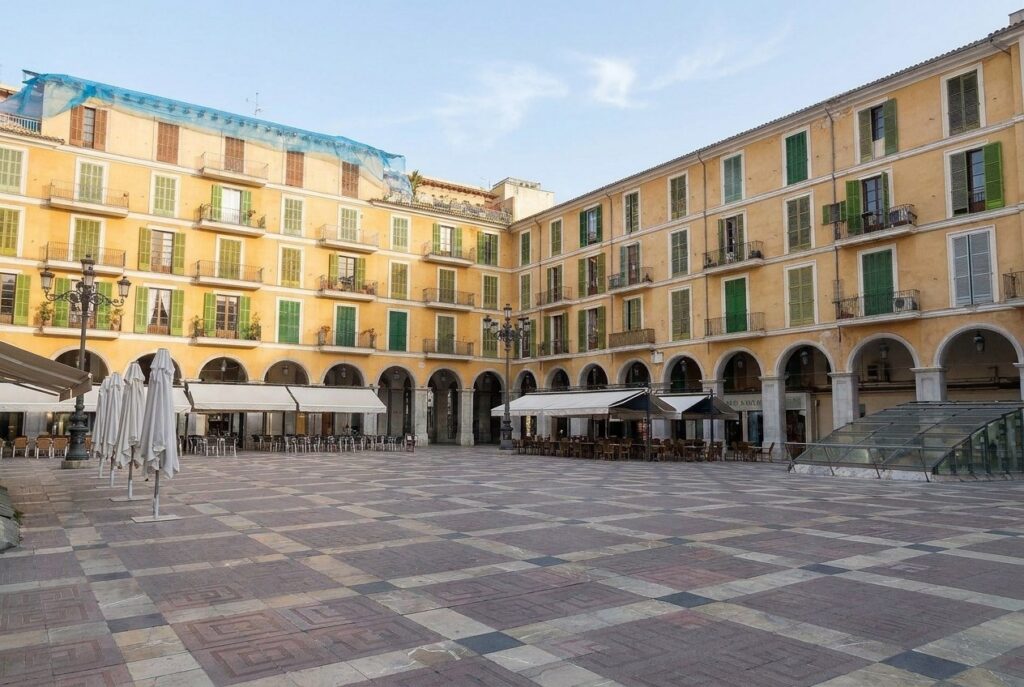
Climb to Plaça Major, the arcaded square of the upper town. Two shopping streets leave it: Sant Miquel and Sindicat. Take the side lanes to three quieter squares: Banc de l’Oli, Mercadal and la Quartera.
- Can Joan de s’Aigo, on Carrer de Can Sanç, is an old café for ice cream, almond horchata and ensaïmadas. It is the pastry stop of the walk.
- Carrer de Can Savellà is narrow and lined with some of the best courtyards in Palma: Can Catllar de Llorer, Can Vivot and Can Juny. Look through the open gates.
For a longer stop, the Mallorcan food guide lists what to order.
Stretch 3: Plaça de Cort, Santa Eulàlia and Sant Francesc
Plaça de Cort holds the town hall and an olive tree about 600 years old, its trunk twisted like rope. Locals use it as a meeting point.
- Santa Eulàlia was the largest parish church of 13th-century Palma, and Jaume II was crowned King of Mallorca there. Its facade and bell tower were rebuilt after the earthquake of 1851. From April to October, you can climb to the terraces of the bell tower, 50 metres up.
- Sant Francesc, a short walk away, has a Gothic cloister built from the 14th to the 16th century and the tomb of the philosopher Ramon Llull. It is usually open from Monday to Saturday, in the morning and again in the late afternoon.
- Carrer de Monti-Sion is thought to be the site of the old synagogue, in the former Jewish quarter.
- Carrer de la Portella is lined with old mansions, among them Ca la Gran Cristiana, home of the Museum of Mallorca.
Close by, in the garden of Can Pit, the Arab Baths are the finest Moorish monument in Palma: a hot room ringed by columns, with a caldarium and a tepidarium.
Stretch 4: La Almudaina and the cathedral
Carrer de la Portella ends at the Dalt Murada, the stretch of medieval wall that runs to the Almudaina arch. The Parc de la Mar and the sea lie below.
- La Almudaina, the royal palace, is of Roman origin and was a Moorish fortress. Its parade ground, the Gothic chapel of Santa Anna and the terraces are open to visitors.
- The cathedral ends the walk. It opens Monday to Saturday from 10:00 and is closed to visitors on Sundays. Entry is €11, with the Museum of Sacred Art.
- The Parc de la Mar, below the walls, has the classic view of the cathedral reflected in its lake.
Entry
Cathedral of Mallorca Skip-the-Line Entry Ticket
1 to 2 hours, from €17, free cancellation
La Llotja and the harbour side
West of the walk, by the harbour, La Llotja is the old merchants’ exchange, a masterpiece of civil Gothic by Guillem Sagrera. Its columns rise like stone palm trees. It is usually open in the morning and again from late afternoon, into the evening in summer. The streets around it fill with bars in the evening.
A morning on the route
- Es BaluardThe bastion and the view of the old wall.
- Plaça de WeylerThe Gran Hotel and the Forn des Teatre shop front.
- Can Joan de s’AigoAn ensaïmada or an almond horchata in the old café.
- Can Savellà and Plaça de CortCourtyards, the town hall and its olive tree.
- Sant FrancescThe cloister and Ramon Llull’s tomb, before the midday closure.
- CathedralYour time slot at La Seu, then the Dalt Murada and the Parc de la Mar.
On a Saturday, the cathedral closes at 14:15. On a Sunday it is closed to visitors: walk the route and end at the Parc de la Mar.
Palma old town questions
How long does it take to walk Palma’s old town?
A morning at an easy pace, from Es Baluard to the cathedral. Add an hour or two for visits inside.
What is the best area of Palma old town?
The lanes between Plaça Major, Plaça de Cort and the cathedral, with the courtyards of Can Savellà and the churches of Santa Eulàlia and Sant Francesc.
Can you see the courtyards of Palma?
From the street, through the gates. Casal Balaguer has the best courtyard open to the public.
Is Palma old town free?
Walking is free. The cathedral, La Almudaina, the Arab Baths and some churches charge for entry.
Read next
- Palma Cathedral (La Seu)Tickets, hours and the terraces of La Seu
- Palma de MallorcaThe rest of the capital, from Bellver to the beaches
- What to eat in MallorcaWhat to eat on the way, from ensaïmadas to tapas