Serra de Tramuntana: the mountain villages and roads
Updated 24 November 2026. Fares, opening hours and walking stages checked the same day.
The Serra de Tramuntana is the mountain range that runs for about 90 km along the north-west coast of Mallorca, from Calvià to Pollença. Centuries of farming have shaped its steep slopes into terraces held up by dry-stone walls, with stone villages, monasteries and watchtowers in between. This page sets out the range, its villages and roads, and the best ways to see it in one to three days.
Quick answer
- World Heritage: the Tramuntana has been on UNESCO’s list as a cultural landscape since 2011.
- Villages: Valldemossa, Deià, Sóller and its port, Fornalutx and the sanctuary of Lluc, linked by one mountain road.
- Without a car: the Sóller train from Palma, the tram to the port and the boat to Sa Calobra.
- On foot: the GR 221 crosses the range in nine stages, with refuges.
On this page
- World Heritage UNESCO, 2011
- The villages six places
- The roads Sa Calobra, 12 km
- Without a car train, tram, boat
- Walking GR 221, nine stages
- How many days one to three
- FAQ
The Tramuntana in one day: the Sóller train, the tram, the boat along the cliffs and the Sa Calobra road
On this page
The Tramuntana in one day: the Sóller train, the tram, the boat along the cliffs and the Sa Calobra road
We may earn a commission when you book through our links. How it works
A World Heritage landscape
UNESCO listed the Cultural Landscape of the Serra de Tramuntana in 2011. The protected area covers 30,745 hectares, with a buffer zone of 78,617 hectares around it. What the listing protects is the work of people as much as the mountains:
- Terraces: slopes too steep to farm turned into narrow fields of olives, fruit trees and vegetables, held up by dry-stone walls.
- Water works: underground channels, canals, ditches and storage tanks, a mix of Arab techniques and the farming know-how of the Christian settlers who took the island in the 13th century.
- Estates and villages: large farming estates, the possessions, with villages, churches, sanctuaries, towers and lighthouses among the terraces.
The Consell de Mallorca looks after the range through the Serra de Tramuntana Consortium, and restores the old paths that now carry the GR 221.
The villages of the Tramuntana
From the south-west to the north-east, the main stops are:
| Place | What it is | Do not miss |
|---|---|---|
| Valldemossa | Village around a royal palace and Charterhouse | The Charterhouse, €12.50, closed on Sundays |
| Deià | Village on a hill above the sea | Robert Graves’s house, €10, weekdays |
| Sóller and Port de Sóller | Valley town and its harbour | The tram between the two, €10 |
| Fornalutx | Stone village at the head of the Sóller valley | The walk from Sóller, an hour |
| Sa Calobra | Harbour at the mouth of a canyon | The Torrent de Pareis |
| Lluc | Mallorca’s sanctuary, in the mountains | The Blauets choir, 13:15 on weekdays |
Tramuntana tours
Mallorca in One Day Sightseeing Tour with Boat Ride and Vintage Train
The mountain road to Sa Calobra, the boat to Port de Sóller, then the tram and the wooden train back to Palma.
9 hours
Free cancellation
Full dayThe classicfrom €99
Booked on Viator
Mallorca Full Day Tour Valldemossa Deià and Sóller Experience
The three villages of the west side, with time in each and stops at viewpoints along the coast.
7 hours
Free cancellation
Small groupThree villagesfrom €95
Booked on Viator
Sierra de Tramuntana hike with small picnic
A guided section of the Dry Stone Route, past old estates, for those who would rather walk than drive.
4 to 5 hours
Free cancellation
Half dayOn footfrom €71
Booked on Viator
The roads through the mountains
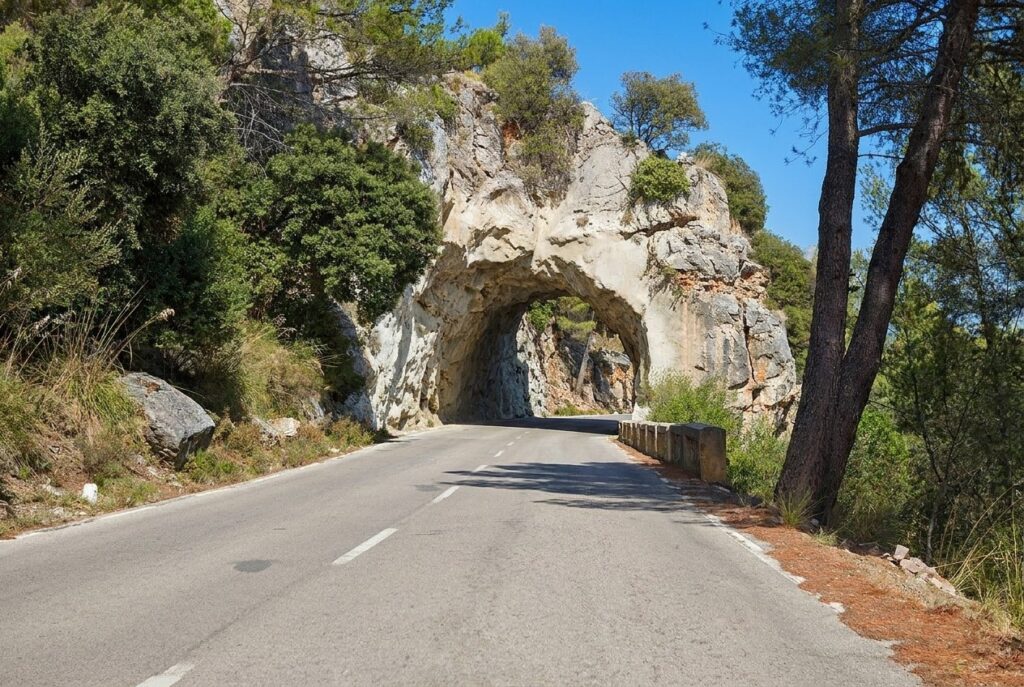
One mountain road links the villages, from Valldemossa and Deià to Sóller, then climbs into the high mountains towards Lluc and Pollença. Two detours are worth the effort, and the whole road calls for care:
- Sa Calobra: from Cals Reis, about 12 km of hairpins drop more than 800 metres to the sea, with a loop where the road passes under itself. Built in the early 1930s, it is narrow and busy: details in our Sa Calobra guide.
- Port de Sóller: the short road from Sóller to the bay, also served by the tram.
- Driving tips: narrow stretches, few barriers, coaches and many road cyclists. Allow more time than the map suggests, and read our car hire advice before you book.
Car
Car hire at Palma de Mallorca Airport (PMI)
Prices from several hire companies for your dates
Cyclists come for the same climbs: our cycling guide covers the routes.
The Tramuntana without a car
- The Sóller train: wooden carriages from Palma to Sóller since 1912, about an hour through 13 tunnels, €23 one way. The train stops for some weeks of works in winter: check the dates on the official site before you plan around it.
- The tram: from Sóller to Port de Sóller in half an hour, €10 each way.
- The boat: from Port de Sóller to Sa Calobra in about an hour, from April to October, €35 return.
- Buses: TIB line 203 runs from Palma to Port de Sóller through Valldemossa and Deià.
- Tours: an island tour strings the train, tram, boat and the Sa Calobra road into one day.
Buses and roads across the rest of the island are in our guide to getting around.
Walking in the Tramuntana
The GR 221, the Dry Stone Route, crosses the range from Port d’Andratx to Port de Pollença in nine stages, about 150 km in all, on old paths restored by the Consell de Mallorca. Its highest point, the Coll de ses Cases de sa Neu, is just over 1,200 metres. Six refuges along the way are booked online.
- Easiest stage: Deià to Port de Sóller, 9.9 km in about three hours, through olive terraces.
- Short walks: Sóller to Fornalutx through the orange groves, about an hour, or the 20 to 30-minute Rosary path at Lluc.
- With a guide: the canyon of the Torrent de Pareis, which ends at Sa Calobra.
Every stage, refuge and day walk is in our hiking guide.
How many days in the Tramuntana
| Time | What to do |
|---|---|
| One day | The island tour: train, tram, boat and the Sa Calobra road; or Valldemossa, Deià and Sóller by car |
| Two days | Day 1 Valldemossa and Deià; day 2 the train to Sóller, the tram and the boat to Sa Calobra |
| Three days | Add a walk: Deià to Port de Sóller, or Fornalutx, then Lluc on the drive north |
Sleeping in the valley saves the drive back to the coast each night: compare Sóller, the port and the rest of the island in our guide to where to stay. A longer plan is in our Mallorca itinerary.
Serra de Tramuntana questions
Why is the Serra de Tramuntana a World Heritage site?
UNESCO listed it in 2011 as a cultural landscape: terraces, dry-stone walls and water works built over centuries to farm a steep, dry range.
What are the best villages in the Serra de Tramuntana?
Valldemossa, Deià, Sóller and Port de Sóller, Fornalutx, and the sanctuary of Lluc.
Can you visit the Tramuntana without a car?
Yes: the Sóller train, the tram, the boat to Sa Calobra and TIB buses to Valldemossa and Deià, or a day tour.
How do you get to Sa Calobra?
By about 12 km of hairpins from Cals Reis, or by boat from Port de Sóller in about an hour from April to October.
Is the GR 221 hard?
Some stages are long and steep, up to about nine hours. Others, like Deià to Port de Sóller, are easy and short.
Read next
- The Sóller train from PalmaFares and timetables of the train and tram
- Sa Calobra and the Torrent de PareisThe road or the boat to the canyon
- Hiking in MallorcaThe GR 221 stage by stage